
book a free workout
Call Us: 416-716-2348

Intermittent fasting is one of the most popular health and fitness trends. It has left people wondering how skipping breakfast can be so effective, given that we have always been taught that it is the most important meal of the day. More and more people are embracing intermittent fasting to lose weight and improve their health. However, attempting it without doing proper research will lead to you missing out on its benefits.
In this brief and simple guide for beginners, our personal trainers will teach you the basics of intermittent fasting and how to get started.
Intermittent fasting is a pattern of eating, not a diet plan. It is a conscious decision to skip meals. The pattern cycles between periods of fasting and eating. It is fasting, not starvation.
The idea is that you eat during a short window of the day and fast the rest. It’s a way of scheduling your meals so you derive the most out of them. There’s no specific type of food you should or shouldn’t eat. Intermittent fasting doesn’t change what you eat, it changes when you eat. It is an effective way to correct imbalances of the hormones responsible for weight gain and obesity. When you restrain yourself from eating for specific periods of time you force your body to function without food, i.e. a fasting state.
One of the most common questions people ask is whether it’s worthwhile. This type of diet promotes a change in body composition through loss of fat mass and weight. It also improves blood pressure and cholesterol levels.
This type of calorie restriction helps take off ‘bad’ weight while keeping on ‘good’ weight. Because you are consuming many calories in one period and fasting for a longer one, it takes your body into a fasting state where it adjusts hormone levels to make stored body fat more accessible. As a result, you start losing fat quickly. However, intermittent fasting doesn’t let your body adapt to the calorie restriction because of a prolonged low-calorie diet and prevents further weight loss. In fact, it addresses the problem by cycling between a low-calorie level for a brief time followed by normal eating, which helps prevent these adaptations.
There are several ways of fasting intermittently. Each involves splitting the day or week into eating and fasting periods. You can fast for shorter periods whenever you like but longer fasts should be started only after consulting an experienced personal trainer and a dietician. Some popular methods are:
Also known as the Leangains protocol, this method involves daily fasting for 16 hours. You have to skip breakfast and restrict your daily eating period to 8 hours. For example, you eat your meals between 11:00 am and 7:00 pm and fast for the remaining 16 hours. Generally, this means you either skip breakfast or dinner and eat two or three meals within this 8-hour period.
As the name suggests, this method involves fasting for one day. It can be fasting from dinner to dinner or lunch to lunch. For example, if you eat dinner on Day 1, you skip the next day’s breakfast and lunch and eat dinner again on Day 2. This means you have only one meal a day. This is generally done two or three times per week.
This method was popularized by physician Michael Mosley through his book ‘The Fast Diet’. In this way of fasting, you consume only 500–600 calories on two non-consecutive days of the week but eat normally the other five. These calories can be consumed at any time of the day, either spread throughout or as a single meal.
This is similar to the 24-hour method. The alternate day method involves fasting on alternating days throughout the week. For example, if you eat dinner on Monday evening, you would fast for 24 hours and eat your next meal Tuesday evening. On Wednesday, you eat throughout the day. Then, after dinner on Wednesday, you repeat the cycle and fast until Thursday evening.
This method is inspired by the habits of ancient warriors who would fight or hunt during the day and focus on preparing meals at night. The principle is ‘fast-and-feast’, where you eat small amounts of raw fruits and vegetables throughout the day and then a large meal during a 4-hour window at night. But you need to make sure you get all the nutrients you need from just one meal.
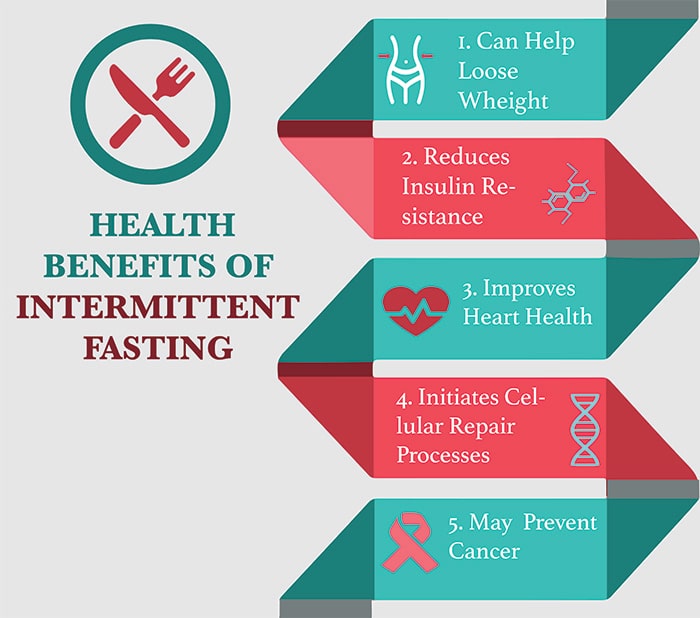
Weight loss is one of the most common reasons why people try intermittent fasting. By making you eat fewer meals, this diet reduces calorie intake. However, there are many other potential benefits to intermittent fasting.
If you have tried all other ways of losing weight, intermittent fasting is your best bet. It is an excellent weight loss tool provided it is done under the supervision of a fitness trainer or dietician. Just keep in mind that the main reason this type of fasting succeeds is that it helps you consume fewer calories. If you eat massive amounts of food at frequent intervals during your eating periods, you will derive none of the benefits.