
book a free workout
Call Us: 416-716-2348

The current war on obesity means we are bombarded with campaigns and advertisements proclaiming the health benefits of working out regularly. From the rising popularity of Fitbit to Michelle Obama’s “Let’s Move” campaign, we are flooded with messages that regular physical activity is important.
That has led many of us to develop a toxic relationship with exercise in order to achieve and maintain the perfect body. But any personal trainer will tell you that this mindset does more harm than good; that includes both your physical and mental health.
Watch out for these signs to understand whether or not you have an unhealthy relationship with exercise.
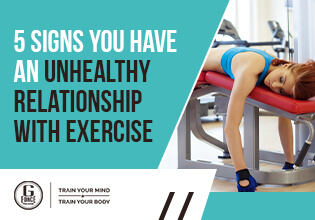
Our private personal fitness trainers have rounded up some telltale signs to help you understand if you’ve developed an unhealthy relationship with working out.
Do you feel terrible if you’ve missed working out a single day? Do absurd thoughts cross your mind, such as ‘what if I lose muscle mass or gain weight?’
In such instances, you should try to calm your mind and relax. Indulge in doing something you enjoy or something that takes your mind off anxiety you are feeling. Or, you can meditate. Remember, taking a break and missing out on a few workouts here and there isn’t the end of the world.
Also, humans are social creatures so it’s necessary to maintain a healthy social life to ensure your mental health doesn’t suffer. It’s absolutely normal to take breaks from your routine as long as you can be consistent enough to get back on track the next day.
Some people think it’s okay to reward themselves with unhealthy food choices after every workout. Alternatively, many of us compensate for the things we consume by over-exercising. Both are unhealthy habits.
Our bodies are genetically designed to maintain a certain weight range. So, by following your hunger cues and eating healthy foods without restricting the intake, you will see your weight stabilize at an acceptable range.
Remember: weight cannot be controlled by exercising. A variety of genetic and biological factors influence our weight. Plus, it’s possible to maintain a healthy diet by consuming things you want to eat in moderation.
Unhealthy exercise habits can make you feel exhausted and fatigued from overexertion while ignoring their taking care of your body. In the long run, this puts unnecessary stress on your body’s systems which may result in you becoming injured or sick from working out too much. For instance, forcing yourself to do different leg workouts when your knee is injured can worsen your condition. While doing a few extra reps is perfectly fine, remember not to push yourself beyond your limits.
In terms of working out, your goal should be to feel better once you’re done, not worse. Here are some indications that your healthy habits may be transitioning into a dangerous compulsion or unhealthy obsession:
Forcing yourself to keep exercising to get rid of these feelings only leads to more compulsive habits. That’s why it’s important to accept that your body requires breaks every now and then and that with a healthy routine, you will feel great even on days off.
Obsessing over changing specific body parts isn’t good for your physical or mental health. Ultimately, the goal should be to feel better, not look a certain way. Every body is unique, and what you see on television, social media, or in magazines isn’t necessarily possible for you to achieve. As mentioned, every body is designed to stay within a certain weight range so thinking you can drastically transform how you look is a wrongheaded notion. Also, it’s impossible to spot train and only reduce fat from certain areas of your body so don’t be fooled by what you see online. Keep in mind that exercising shouldn’t be focused on the number on the scales but on how it’s making you feel.
What to Do If You Think Your Relationship with Exercise Is Becoming Toxic
It can be difficult to find and maintain a balance between healthy exercise habits and unhealthy ones on your own. Some individuals may need to seek professional help, whether from a private personal trainer or a mental health specialist. While the former can guide your exercise habits, the latter can ensure you stay in a good state of mind to pursue your goals. Furthermore, a personal trainer will be able to design a routine that helps you achieve the best possible results. This will help you find ways to make fitness a balanced part of your life.
While exercising offers many mental and physical health benefits, doing it excessively or mindlessly can cause immense harm to your mind and body. Over time, it may also fuel other obsessive-compulsive disorders including bulimia or anorexia, or those related to body image and eating. A great way to ensure you stay healthy without overdoing it is to listen to your body, follow your intuition, and listen to your private personal trainer.